




According to recent OSHA reports, 125,000 workplace injuries per year occur due to crushing against objects. In manufacturing - where operators interact daily with machinery and robots - proper implementation of safety distances is paramount to prevent potentially fatal accidents and costly sanctions.
The Regulatory Context
The EN ISO 13854 Standard specifies “minimum gaps to avoid crushing of parts of the human body” during machinery operation. It applies exclusively to risks arising from crushing hazards and not to other potential hazards such as impact, shearing, or drawing-in.
Minimum Safety Gaps: A 4-Phase Approach
This Type B1 Standard – which has definitively replaced the previous EN 349:1993+A1:2008 – integrates with other Standards such as EN ISO 12100 on Risk Assessment and EN ISO 13857 on safety distances. Together, they define an iterative strategy in multiple phases to determine minimum safety gaps for operators in industrial areas.
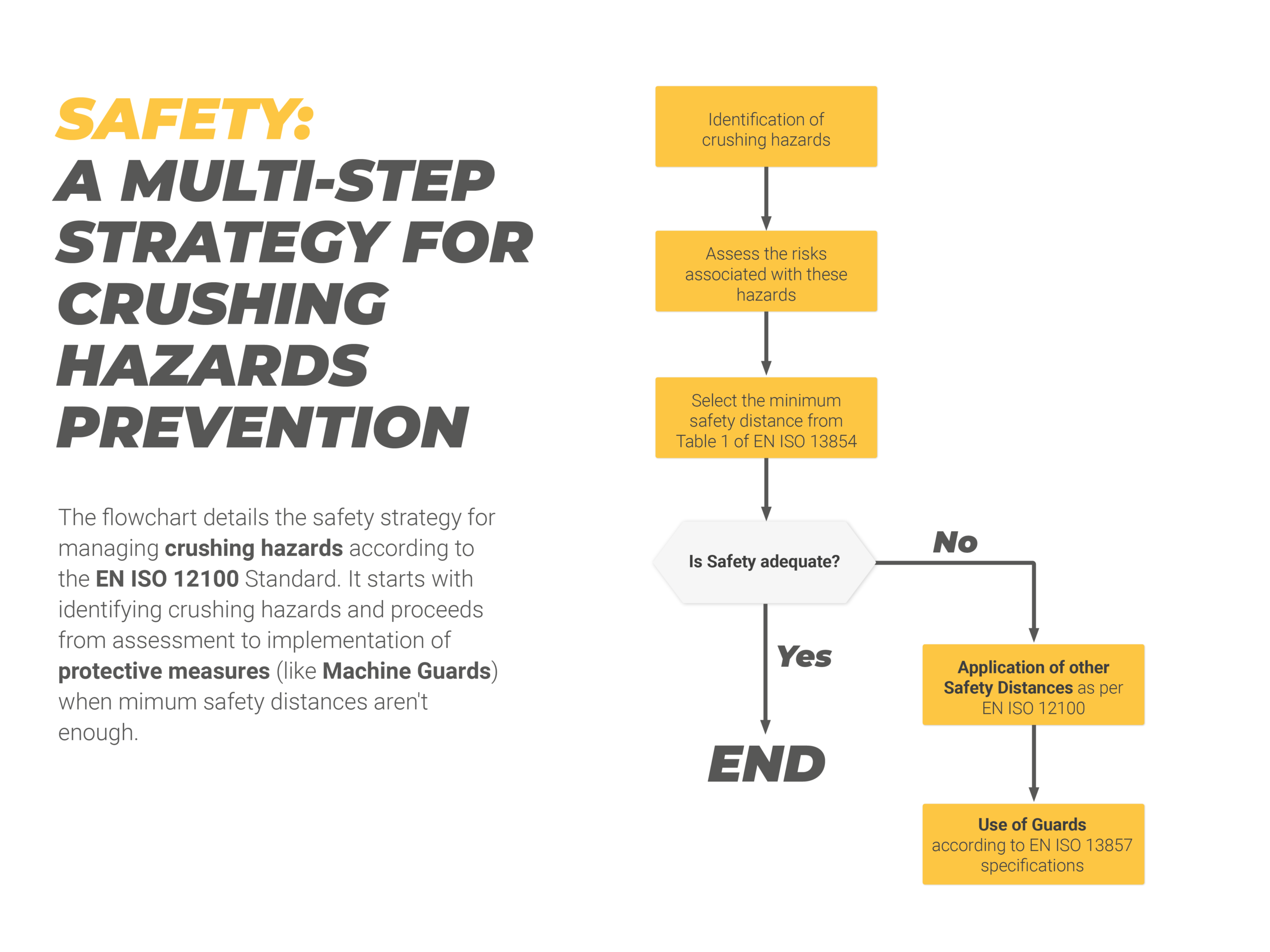
1. Identification of Crushing Hazards
The EN ISO 13854 defines a “crushing zone” as an area where the human body or parts of it are exposed to risks generated by two moving parts moving toward each other or by a moving part moving toward a fixed part.
Based on this definition, machinery designers and manufacturers must preventively identify which parts of the plant represent zones with crushing hazards during the Risk Assessment phase.
Working in the sector, some of these examples might sound familiar:
- Presses and Stamping Machines: the convergence point between die and matrix, considering both vertical movement and applied pressure
- Conveyor Belts: transfer points where return rollers or junction points can generate crushing
- Robotic Systems: axis movement spaces, including zones of potential interference between moving parts and surrounding structures
- Packaging Systems: closing, sealing, and handling mechanisms where multiple components interact simultaneously
- Machine Tools: intersection points between moving tools and fixed components, including tool change systems
Each of these deserves unique considerations and must be analyzed based on the specific features of the machine, such as the speed of moving components, forces involved, and frequency of operator access.

2. Assessment of Associated Risks
A common mistake during Risk Assessment is considering only zones with crushing hazards before determining minimum safety gaps.
The process described in EN ISO 12100 requires consideration of several additional factors that are sometimes overlooked, such as:
- Multi-part Assessment: if it's foreseeable that the crushing risk could involve different body parts, the minimum gap relative to the largest part among these must be applied
- Unpredictable behaviors of people and their body dimensions
- Thick or bulky Protective Clothing (for example, Personal Protective Equipment (PPE) for welding or extreme temperatures) and tools necessary for operations
- Safety footwear that increases the effective foot size

3. Application of Minimum Safety Gaps
Once these aspects have been taken into account, it is possible to determine the minimum gaps necessary to protect different body parts. The EN ISO 13854 Standard provides precise values – calculated based on reference anthropometric values – ranging from a few millimeters for the smallest parts (e.g. a finger) to several centimeters for larger ones (a person’s body).
These parameters must be considered already during the machine design phase: structural changes at a later stage can be complex and costly.


4. Use of Protective Guards
If, for technical or design reasons, it is not possible to comply with the values indicated in Table 1 (particularly for the largest anticipated body part), the EN ISO 12100 Standard requires the application of "additional or other measures and/or additional means," including Guards.
The effectiveness of Guards depends on four fundamental parameters:
• The space a between the fixed part and the moving part
• The depth b of the crushing zone
• The dimensions c of the opening in the protective structure
• The distance d between the Guard and the crushing zone
In this case, safety distances to prevent reaching dangerous zones are determined according to EN ISO 13857 Standard.

What We Can Do for You: Quality Guards Compliant with Standards

Satech Modular Steel Fences comply with design requirements while being ergonomic and simple to assemble, thanks to a reduced number of components. A complete Catalog of everything necessary for the protection of your industrial plants:
- 5 Protection Systems with and without frame, which can be completed with Panels in Polycarbonate, Sheet Metal, or mixed materials
- Doors for safe access of people, goods, and bulky loads
- Accessories for customizing your safety perimeter
- Safety Locks compliant with all required Performance Levels (PLr)
- Brackets for Safety Switches and Interlocks compatible with major brands’ devices
- CustomGuard Solutions tailored to your needs
We provide a lineup of compliant Modular Steel Fences, made with quality materials, modular and durable over time: a smart investment for the Safety of your operators and production areas.
EN ISO 13854 - Frequently Asked Questions
1. Regulatory Aspects
When is it mandatory to apply EN ISO 13854?
The Standard applies when, following the Risk Assessment, moving parts have been identified that can create crushing zones, i.e. areas where the human body or parts of it may be exposed to risks generated by:
• Two moving parts moving toward each other
• A moving part moving toward a fixed part
How does EN ISO 13854 integrate with other Safety Standards?
EN ISO 13854 is a
What are the differences between EN ISO 13854 and EN ISO 13857?
EN ISO 13854 and EN ISO 13857 have different but complementary purposes:
• The first defines minimum gaps necessary to avoid crushing of body parts between moving parts of the machine. It applies when designing the machine itself and its moving components.
• The second establishes safety distances to be respected when installing Guards to prevent reaching dangerous zones.
2. Practical Applications
How is EN ISO 13854 applied when crushing risk involves multiple body parts?
In this case, the minimum gap relative to the largest body part among those potentially exposed to risk must be applied. For instance, if a zone could involve both the hand and arm, the minimum gap prescribed for the arm must be considered.
How does Personal Protective Equipment (PPE) influence minimum safety gaps according to EN ISO 13854 Standard?
The EN ISO 13854 Standard requires consideration of possible use of thick or bulky protective clothing and safety footwear, which would increase the effective dimensions of body parts exposed to danger. This must be carefully evaluated when determining minimum safety gaps.
How do I manage industrial machinery safety when mandatory Personal Protective Equipment reduces access gaps below minimum values prescribed by technical standards?
When PPE (e.g. thick gloves or safety footwear) reduces access gaps below minimum safety values prescribed by technical standards, it's necessary to document this criticality in the technical file and implement alternative Protection measures.
What safety parameters must be evaluated when installing Guards to prevent access to dangerous zones of industrial machinery?
Installing Guards around industrial machinery requires careful evaluation of four fundamental parameters: the space between fixed and moving machine parts, the depth of the dangerous zone, the size of openings in Guards (such as mesh or grids), and the distance between the Guard and the danger zone.
To determine correct safety distances in relation to openings in Guards, it's necessary to refer to EN ISO 13857 Standard.
